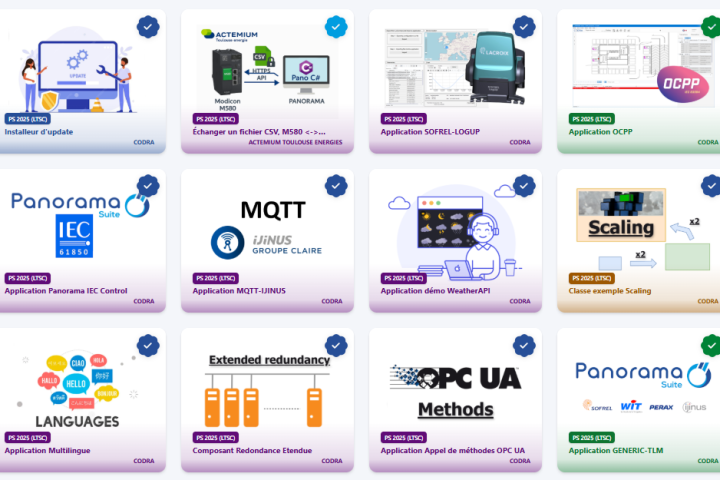
In a SCADA project, performance also depends on the ability to capitalise: reuse what works, speed up design and make technical choices more reliable. CODRA is launching PanoXchange, a new Panorama exchange and resource portal, with a clear objective: to facilitate the sharing, distribution and re-use of content created by CODRA and the Panorama Suite user community, for the direct benefit of projects.
A platform designed for integrators… and end customers
PanoXchange is aimed primarily at two major beneficiaries: integrators and end customers.
For integrators, it is a lever for productivity and quality: having ready-to-use examples speeds up the start-up phases, reduces ‘invisible’ developments (those that are redone for lack of a reference), and standardises approaches from one project to the next. It’s also a way of enhancing their expertise by relying on shared practices that are easier to explain, maintain and develop.
For end customers, the benefits are just as tangible: PanoXchange contributes to projects that are quicker to deliver, more consistent and easier to operate. Operations/maintenance teams benefit indirectly from more consistent developments and tried-and-tested solutions, making them easier to get to grips with over the long term.
To support the launch, just over 20 sample applications were put online as soon as the site opened, to provide useful, actionable resources straight away.
Immediate time savings for all developers
PanoXchange saves time in a very pragmatic way: rather than searching through documentation or support content, allows developers to start with concrete examples, already structured, that show how to implement a function or organise an application. They are no longer just looking for “the right information”; they can see a complete implementation, with a design logic and explicit technical choices.
The benefits of application sharing for the Panorama ecosystem
Application sharing brings several major benefits to SCADA projects and the community:
- Panorama can be used for a wide range of applications;
- Showcasing the talents of Panorama developers;
- Promoting the expertise of integrators;
- Help new Panorama users;
- Share knowledge.
The benefits are very tangible: newcomers learn more quickly thanks to functional examples; experienced teams speed up design by using existing building blocks; and integrators can promote their expertise through reproducible projects that are adapted to industrial realities.
Three types of content to accelerate and inspire
PanoXchange is organised around three complementary categories, covering the ‘quick start’, the targeted example, and the industrialised brick:
- Application templates: “model” applications designed as starting points. They provide a standard structure and organisation that can be quickly adapted to a specific SCADA context.
- Example applications and components: targeted, educational examples that show how to achieve a specific functionality or implementation. They serve as a reusable reference and accelerate the integration of best practices.
- User classes: at CODRA, a user class corresponds to a specific encapsulated and reusable development. It is a building block that extends Panorama and enables a recurring functionality to be industrialised so that it can be reused cleanly on several projects.
Showing the range of possibilities and giving ideas
Another key role of PanoXchange is to inspire: the platform gives ideas, helps to project, and shows the extent of what is possible with Panorama in SCADA projects. Seeing applications, components and user classes that have already been built helps to identify new ways of meeting a need, improving HMI ergonomics, structuring an application, or enhancing an existing solution. In this sense, PanoXchange is both a delivery accelerator and a showcase for what the ecosystem can do.
With PanoXchange, CODRA is reinforcing a virtuous circle: the more integrators and end customers share and reuse, the faster best practice circulates, and the more efficient SCADA projects become. Whether you’re a beginner or an advanced Panorama user, the challenge is the same: spend less time searching and more time building useful, robust and maintainable applications.