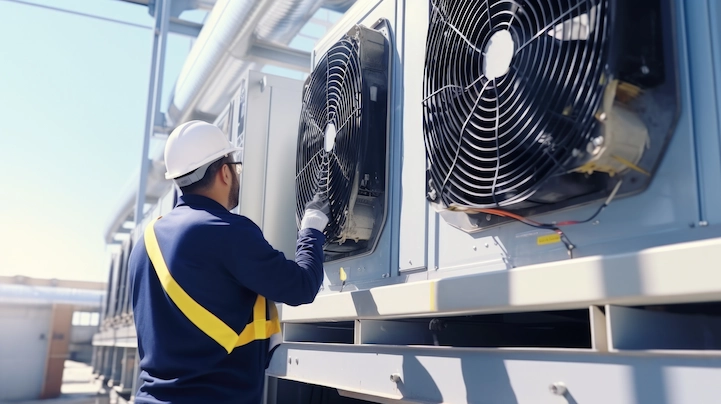
Every day, your facilities generate thousands of measurement points—but no team can monitor everything. Faults often develop unnoticed (drift, overconsumption, inefficiency) and then lead to breakdowns, quality issues or discomfort. With energy costs rising and uptime requirements becoming ever stricter, simply ‘seeing’ is no longer enough: you need to automatically detect deviations in real time
Faults: small causes, big impacts
A fault is not necessarily a clear-cut alarm. It is often a gradual or intermittent deviation: flow rate too high at night, a valve open with no effect, less efficient cooling, an inconsistent sensor, or a motor running hotter than usual. These weak signals pose three major problems:
- Hidden costs: the IEA (International Energy Agency) estimates that energy efficiency policies and programmes can significantly reduce energy demand (a figure often cited is around 10–15 per cent by 2040, depending on the scenario), which illustrates the potential associated with optimisation and the detection of deviations.
- Availability: many breakdowns are not ‘sudden’; they are preceded by symptoms (vibrations, consumption deviations, efficiency losses) that can be detected in historical data… provided one looks for them.
- Operational risk: certain abnormal behaviours (simultaneous heating and cooling, ventilation unsuitable for occupancy levels, electrical arcs, process deviations) increase the risk of incidents, quality issues and premature wear and tear.
In reality, traditional monitoring systems are very effective at displaying and logging data, but they still rely heavily on: (1) human attention, (2) simple thresholds, and (3) hard-coded rules. However, these approaches quickly reach their limits when dealing with hundreds of signals, multiple operating modes and interactions between variables.
Why conventional alarms are no longer sufficient
Thresholds and rules work for simple cases, but they become ineffective when:
- The ‘normal’ situation depends on the context (weather, occupancy, load, production phase);
- The manifests as a gradual deterioration compared with normal behaviour (COP falling at equivalent load, the same flow rate requiring more energy, the machine cycle ‘changing shape’), without necessarily exceeding a fixed threshold.
- The deviation develops gradually over days or weeks, or only appears intermittently (depending on workload, weather or operating mode), making it difficult to detect with one-off alarms
The result: many organisations suffer both from an overload of alarms (leading to a loss of focus) and, paradoxically, from significant faults that slip under the radar.
AFD in Panorama: the AI that keeps your data ‘under control’
AFD (Automatic Fault Detection) is the AI component integrated into Panorama (MES/SCADA/Historian) to automate this monitoring. The core idea is to learn what constitutes normal operation, then detect deviations and raise alerts without you having to write rules for every situation.
In practice, AFD:
- Learns normal behaviour patterns from your historical data.
- Takes into account operating phases (day/night, weekday/weekend, production/shutdown, ramp-up, etc.) to ensure that like is compared with like.
- Monitors continuously: a variable, a piece of equipment, an area or sets of data points, using the same principle.
- Alerts in real time when a situation deviates from expected normality.
The aim: to reduce the marginal cost of monitoring, and above all to detect faults that no one has time to ‘watch out for’ continuously.
Practical use cases: buildings (BMS) and industry
Building Management Systems (BMS) / Smart Buildings
- Comfort & air quality: detection of atypical deviations in temperature, humidity and occupancy, and inconsistencies in control systems.
- Energy: identification of excessive consumption, inefficient heating/cooling, and simultaneous heating and cooling.
- Ventilation (AHU/VAV): abnormally high airflow rates at night or at weekends; inappropriate operating mode despite favourable outdoor conditions.
- Security: detection of abnormal behaviour that may indicate an intrusion or the start of a fire (depending on available signals), even without a dedicated sensor.
Industry / Process & production line
- Process: temperature deviations, pH fluctuations, atypical batch profiles, faults in heating/cooling ramp-up, intermittent dosing faults.
- Critical assets: a motor running hotter than normal, a compressor with fluctuating power consumption, a fan exhibiting abnormal behaviour.
- Preventive maintenance: detection of weak signals (drift in filter ΔP, drop in flow rate at constant speed), counting of intermittent events to trigger the correct intervention at the right time. Expected (and measurable) benefits
Expected (Measurable) Benefits
Implementing automatic fault detection aims to deliver very tangible results:
- Greater availability thanks to earlier detection and faster diagnosis.
- Improved energy efficiency by quickly identifying deviations and inefficiencies.
- Improved process quality by identifying deviations before they impact production (non-conformities/scrap).
- Greater operational efficiency through automated monitoring and more accurate alerts, enabling teams to focus on taking action.
Faults are not exceptions: they are often the first signs of energy drift, equipment deterioration or a process becoming unbalanced. By integrating DAA into Panorama, the aim is to move from ‘reactive’ monitoring to ‘proactive’ monitoring, capable of automatically detecting the unexpected, at the right time, and on a large scale. Ultimately, this means less waste, fewer unplanned stoppages and smoother operations — because teams can act on verified alerts before a deviation escalates into an incident.