

Datalab: signal and image processing software
Open-source software developed by CODRA
HOW did datalab come about?
Renowned for its long-standing expertise in industrial software publishing, CODRA has also been actively involved in open-source software for several years, particularly in the field of data processing and visualisation.
This dual positioning — industrial-grade software and open-source contribution — naturally led to the development of DataLab, a platform designed to address demanding scientific and technical use cases while remaining accessible and extensible.
What is Datalab ?
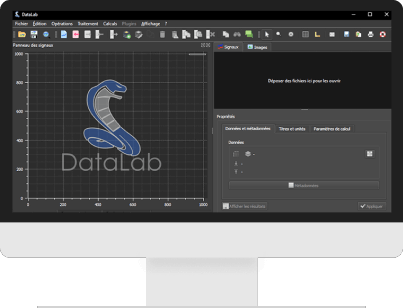
DataLab is an open technical platform dedicated to signal and image processing. Its functional scope is deliberately generic, allowing it to address a wide variety of scientific and technical use cases. With a rich set of features — including advanced processing capabilities — DataLab enables the processing and visualisation of virtually any type of scientific data. It provides scientists, engineers and industrial users with a tool that is easy to use, straightforward to extend, and as reliable as industrial-grade software.
Why open-source software?
Simplicity first
The choice of open-source software was a pragmatic one. This collaborative model makes technology widely accessible while fostering continuous improvement through shared expertise.
With no licensing costs, DataLab can be adopted by a broad range of stakeholders and professions.
Initially developed and used in demanding scientific and technical contexts — where it demonstrated its robustness and relevance — DataLab is now also deployed in industrial environments, where it continues to deliver increasing value.
By developing DataLab as open-source software, CODRA actively contributes to the open-source ecosystem.
Fully aligned with the company’s values, this approach also provides a concrete way to showcase CODRA’s technical expertise and to demonstrate how we support meaningful and sustainable innovation in practice.
What can Datalab be used for?
Work carried out with Datalab
The technical challenges addressed by DataLab users are highly diverse and continuously push the limits of our expertise. A few concrete examples illustrate the nature of the work performed with the platform:
- Processing of experimental signals acquired on large scientific facilities
- Automatic detection of laser spot positions on experimental targets
- Alignment of measurement instruments using image processing techniques
- Automatic pattern detection on images and geometric correction
Depending on the use case, the open-source DataLab software can be deployed in three different ways:
- Standalone mode:
DataLab is used as a full-featured processing application. It can be adapted to specific needs through the development of custom plugins.
- Embedded mode:
DataLab is integrated into your own application to provide advanced processing and visualisation capabilities. - Controlled mode:
DataLab communicates with your application (for example, a Panorama supervision system) to make its processing capabilities available without altering the user experience.
DataLab can also be controlled directly from standard development environments (such as Visual Studio Code or Spyder) to execute processing workflows while benefiting from its advanced features.
DataLab to support You
CODRA develops DataLab to support its customers in their data processing and visualisation activities, in combination with other software needs such as equipment control or system supervision.
DataLab is particularly well suited to proof-of-concept and feasibility phases, where rapid validation of processing workflows is required before committing to full-scale developments.
Thanks to its intuitive user experience and its multiple modes of use, DataLab enables efficient development of data processing and visualisation applications, while relying on a robust, industrial-grade technological foundation.

How does Datalab work?
DataLab is a technological platform dedicated to the processing and visualisation of data, whether signals or images. Developed in Python, it benefits from the richness of the associated ecosystem in terms of scientific and technical libraries.
The main technical features of the open-source DataLab platform include:
- Support for a wide range of standard and proprietary data formats
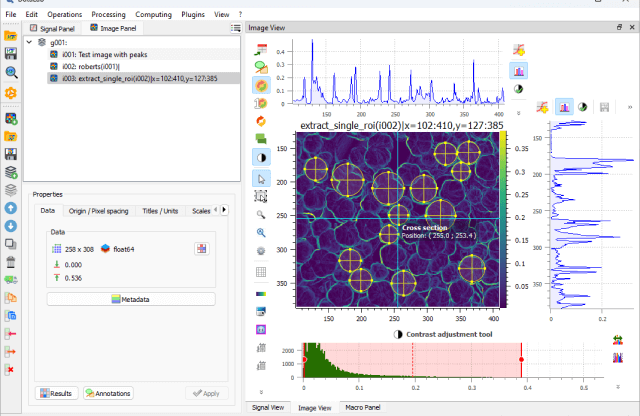
- Ability to open and process an arbitrary number of objects (signals or images), including batch processing and object grouping
- Simultaneous visualisation of multiple objects, with support for annotations
- Standard processing operations on signals and images
- Advanced image processing capabilities (restoration, morphology, contour detection, etc.)
- Management of regions of interest (ROI): extractions, computation and analysis
- Macro command editor
- Remotely controllable public API
- Embedded interactive Python console
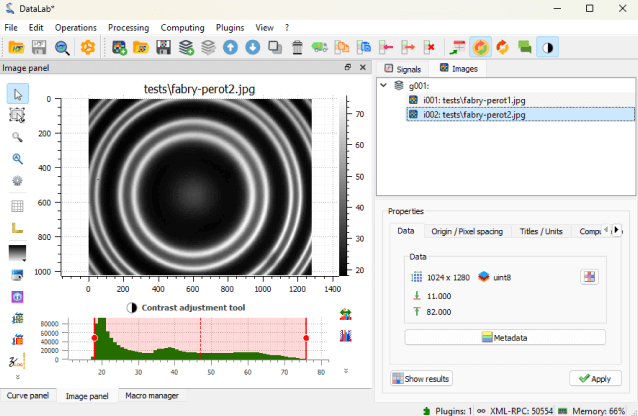

DataLab stands out for four key strengths:
- Extensibility:
DataLab features a powerful plugin architecture that makes it easy to implement new capabilities, such as custom processing functions, proprietary file formats or dedicated user interfaces. It can therefore be used not only as an application, but also as a highly customisable technical platform. - Interoperability:
DataLab can be embedded into existing software environments, including monitoring and supervision systems such as Panorama Suite.
It can be used in advanced SCADA systems, equipment-level control applications or test bench software, for example in non-destructive testing or positioning control contexts - Automation:
A high-level public API allows DataLab to be fully controlled remotely, enabling automated data loading, processing and analysis workflows. - Maintainability and testability:
DataLab is designed as industrial-grade scientific and technical software. Its automated test suite covers approximately 90% of the codebase, which is particularly significant for software with a rich graphical user interface and greatly helps to reduce regression risks.
Researchers, engineers and scientists can rely on DataLab to address demanding data processing challenges. Its open-source model also makes it possible to reintegrate project-specific developments into the wider open-source ecosystem — an approach that reflects CODRA’s commitment to sustainable and responsible software engineering.