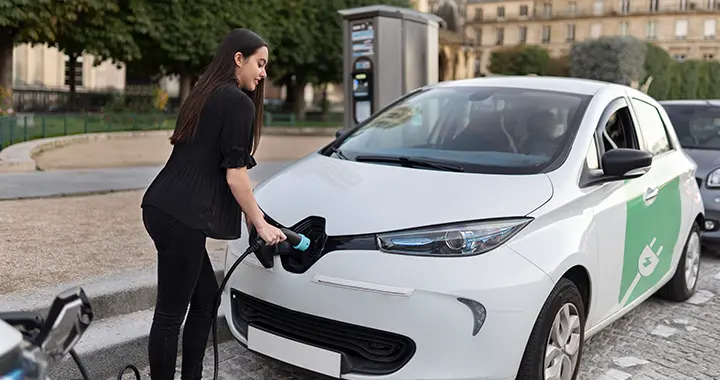
An IRVE charging network behaves like a distributed industrial installation: dozens of heterogeneous devices, spread across several sites, that must stay continuously available. EV charging station SCADA is the discipline of managing this estate remotely, detecting faults and securing billing.
Without it, an operator runs a critical asset blind, and every hour of downtime erodes service and revenue.
Key takeaways
- EV charging station SCADA remotely manages an IRVE network: real-time status, alarms, transactions and billing.
- OCPP is the standard protocol between charge points and the SCADA platform, in versions 1.6, 2.0.1 and 2.1.
- OCPI handles roaming between operators, while OCPP links each charge point to its central system.
- An IRVE network is monitored on the same principles as any SCADA installation: multi-protocol, real time, cybersecurity.
- Service continuity rests on remote management, network resilience and OT security of the charge points.
What is EV charging station SCADA?
EV charging station SCADA is the centralised, remote and real-time control of a network of charge points. The platform collects the status of each unit, raises alarms, authorises sessions and forwards operational data to a central system. It turns isolated devices into a network that can be monitored, measured and billed.
This function is no longer optional. In France, any charge point above 3.7 kW must be installed by an IRVE-qualified professional, and since 2024 the European AFIR regulation has raised interoperability and roaming requirements. Central supervision becomes the precondition for these service obligations.
OCPP, the core protocol of EV charging station SCADA
OCPP (Open Charge Point Protocol) is the open protocol that links a charge point to its SCADA platform, known as the CSMS. Maintained by the Open Charge Alliance, it standardises the exchanges: session start, consumption metering, software updates and fault reporting. It is the building block that frees a network from the charge point manufacturer.
Three versions coexist today. OCPP 1.6 remains the most widely deployed, OCPP 2.0.1 strengthens security and smart charging, and OCPP 2.1, published on 23 January 2025, adds bidirectional V2X charging, ISO 15118-20 support and integration of distributed energy resources.
OCPP never works alone in a mature network. OCPI (Open Charge Point Interface) handles roaming between operators, so that a user from one network can charge on another. ISO 15118 drives Plug and Charge, which authenticates the vehicle without a badge. A robust SCADA platform orchestrates these protocols together.
Running an IRVE network as a SCADA installation
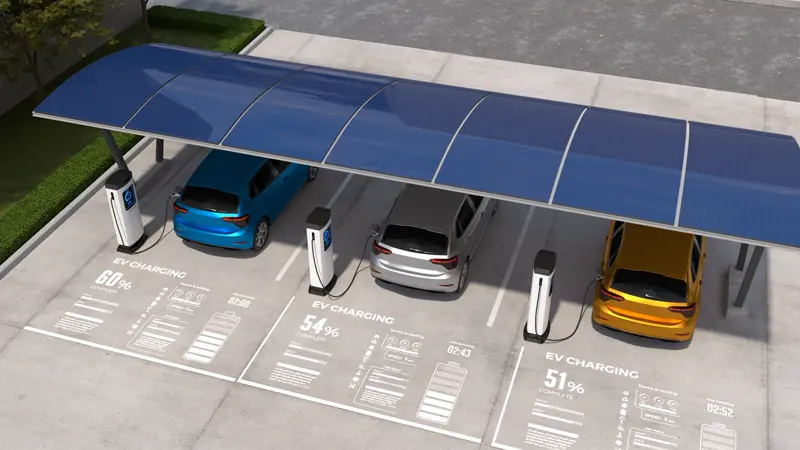
EV charging station SCADA rests on the same principles as any industrial installation driven by a SCADA platform. Charge points are geo-distributed, communicating and critical assets, exactly the ground of a SCADA platform such as Panorama E2. Geo-SCADA maps charge points across a territory and ties their status to their location.
The core difficulty is the multi-protocol reality. A real network mixes several generations of OCPP, charge points from different suppliers and sometimes ancillary Modbus or IEC 61850 equipment for the electrical side. A device-independent communication layer, such as Panorama COM, aggregates these heterogeneous flows into a single, coherent SCADA view.
Recorded data completes real-time control. Archiving sessions, power draw and faults feeds AFIR regulatory reporting, energy optimisation and predictive maintenance. A Data Historian such as Panorama H2 keeps this data over time and restores it as actionable dashboards.
Service continuity and EV charging station SCADA
Service continuity is the ultimate goal of any charging estate, because an unavailable charge point is invisible from a central office. Remote management, through an Edge to Service approach, lets an operator diagnose, restart and update a charge point remotely, without dispatching a technician every time.
Network resilience governs this availability. Edge processing, close to the charge points, keeps essential functions running even when the central link drops, then resynchronises data once it is restored. This Edge architecture prevents a connectivity failure from freezing an entire charging site.
OT cybersecurity closes the loop. A supervised IRVE network exposes remote-command interfaces that become an attack surface. Relying on a proven platform, such as the Panorama E2 SCADA platform certified CSPN by ANSSI (the French National Cybersecurity Agency), anchors EV charging station SCADA in a recognised security framework rather than in promises of invulnerability. IEC 62443 and ISO 27001 add international anchors for non-French operators.
Treating charging as an industrial system
Running an IRVE network means treating charging as a full industrial system: interoperable through OCPP and OCPI, resilient through the Edge and secured to OT standards. EV charging station SCADA is not a software overlay, but the infrastructure that guarantees availability, compliance and revenue.
A European leader in SCADA software for almost 40 years, CODRA equips this requirement with an open, multi-protocol Panorama Suite certified CSPN. To refine the architecture that fits your network, explore our SCADA platform and talk to our experts.