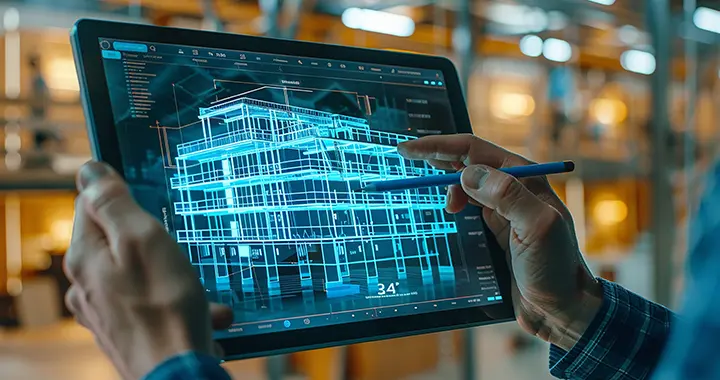
A building’s digital model contains thousands of pieces of structured data: geometry, materials, equipment, services. Yet, in the majority of projects, this data remains under-utilised once the building is handed over. BIM is designed for construction; rarely for the 40 to 60 years of operation that follow.
BIM in the design phase: modelling to inform decision-making
BIM refers both to a collaborative working process and to the resulting digital model: a 3D model enriched with technical and functional data that can be utilised by all project stakeholders. During the design phase, it enables architects, design consultancies and project owners to work from a shared reference framework, eliminating inconsistencies between disciplines.
In practice, the value of Building Information Modelling in design is measured first and foremost by conflict detection. Clash detection tools automatically identify interferences between HVAC, electrical and structural systems before a single spade is put in the ground. According to building SMART International, this approach reduces on-site non-conformities by an average of 40% on complex projects.
The construction phase: BIM as an execution reference
On site, BIM becomes an operational management tool. Field teams access the digital model via tablets to check dimensions, validate installations and document progress in real time. Any deviation between the planned and the actual is recorded directly in the model, feeding into the ‘as-built’ model, which reflects the actual construction.
This traceability is fundamental for the next phase. An as-built model that is incomplete or not kept up to date during construction deprives operations teams of a reliable digital asset. Building Information Modelling today lays the groundwork for tomorrow’s maintenance.
O&M: when BIM enters the operational phase
Operations and Maintenance Management (OMM) refers to all the activities that ensure a building functions properly after handover: operation of technical equipment and systems, preventive and corrective maintenance, monitoring of consumption, and management of interventions. This is the longest phase of the life cycle, and historically the one least well-equipped digitally.
BIM is a game-changer, provided it is implemented correctly. Upon handover, the As-Built Documentation (ABD) takes digital form: the as-built model enriched with manufacturers’ technical data sheets, maintenance plans and warranty data. This digital ABD becomes the foundation of O&M. Each piece of equipment is identified within it, along with its specifications, precise location and maintenance requirements: information that feeds directly into the CMMS and preventive maintenance schedules.
In practice, a facility manager working from an up-to-date BIM can instantly locate the relevant equipment during a service call, access its technical data sheet without sifting through paper archives, and document the operation directly within the model. On a hospital campus or at an airport, where hundreds of critical pieces of equipment coexist, this increase in efficiency is transformative.
Panorama E2: managing the building via the digital model
Panorama E2 is CODRA’s SCADA/HMI platform, which enables the collection, analysis and control of data generated by a building’s equipment. It is on this basis that it addresses three complementary operational functions: Building Management Systems (BMS), Facility Management (CTM) and BIM for operation.
The BIM for operation module of Panorama E2 directly integrates the digital model into the SCADA interface. The operator navigates the building’s 3D model as they would a traditional synoptic diagram, with real-time data overlaid on each piece of equipment. When an alarm is triggered, the operator can visually locate the affected equipment within the model, check its current status and initiate a corrective action without switching tools. On sites with a high density of equipment (data centres, hospitals, multi-site commercial buildings), this consolidation significantly reduces diagnosis and escalation times.
As operational data accumulates in the model via Panorama E2, Building Information Modelling evolves into an operational digital twin. Performance deviations become detectable before a failure occurs. In an HVAC network, an 8% deviation in the consumption of a chiller unit can signal fouling two to three weeks before an incident, transforming costly corrective maintenance into a planned intervention.
Energy efficiency: BIM supporting decarbonisation
The RE2020 regulations and the decarbonisation targets for France’s building stock require precise monitoring of energy consumption throughout the entire lifecycle of buildings. BIM provides the necessary geometric and technical framework, but it is during the GEM phase that real-world data enables reduction strategies to be refined.
Panorama E2 allows you to compare actual consumption with theoretical consumption, item by item and zone by zone, directly from the digital model. Identified discrepancies become traceable corrective actions, anchored in the Building Information Modelling (BIM) model and documented for regulatory audits.
BIM is not a design tool; it is a digital asset that underpins a building’s entire lifecycle. Its full potential is realised during the operations and maintenance phase, provided that a reliable as-built model has been maintained and connected to a real-time SCADA platform. CODRA’s Panorama E2 effectively achieves this digital continuity, from building management systems (BMS) and Facility Management systems (BCS) right through to BIM for operation.