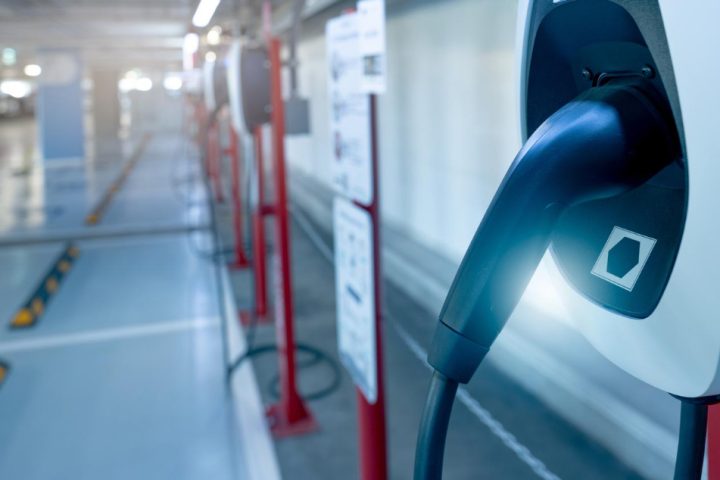
Electric vehicle (EV) charging points are being deployed rapidly in commercial buildings. For operators, they are becoming a new technical asset to be maintained and optimised; for users, they represent an expected service that is often critical on a daily basis. While integrating EV charging points into your SCADA system is a matter of course, your application still needs to be compatible with the leading protocol: OCPP.
The massive arrival of EV charging points in commercial buildings: a new operational challenge
More and more charging points are being installed in commercial buildings: office car parks, shopping centres, industrial sites, hospitals, campuses, hotels, logistics platforms, etc. This trend is accelerating as a result of the growing popularity of electric vehicles, user expectations and decarbonisation targets. Recharging is becoming a basic service, in the same way as connectivity and safety.
But operations are becoming more complex. An electric charging point is not simply an electrical consumer: it is a connected piece of equipment, with variable use, that can mobilise significant power. Several simultaneous loads can create peaks, increase the bill (both for the building and for the user), or strain the electrical infrastructure. Availability is also becoming a sensitive issue: a faulty terminal immediately results in calls to the reception, facility management or support teams. Finally, fleets quickly become heterogeneous, with different models and versions, which makes monitoring difficult without interoperability standards.
Why integrate EV charging points into your SCADA application, and how Panorama can help you?
Integrating charging points into your SCADA application means you can move away from ‘separate’ management via manufacturer portals. A SCADA application, such as the one developed with Panorama, centralises data, structures operation and prepares the building for energy optimisation.
Unified monitoring and simplified operation
SCADA softwares can include a CSMS (Charging Station Management System) functionality, as is the case with Panorama. This enables it to centralise the status of all charging stations and connectors. The operator can view availability, faults and electrical measurements in real time. The maintenance team can quickly identify the bollard concerned and the nature of the incident. The operations manager reduces diagnostic time thanks to unique screens and mimics. SCADA brings together technical information in a single tool, eliminating the need for multiple portals. The operators can standardise intervention procedures across the whole range of charging stations.
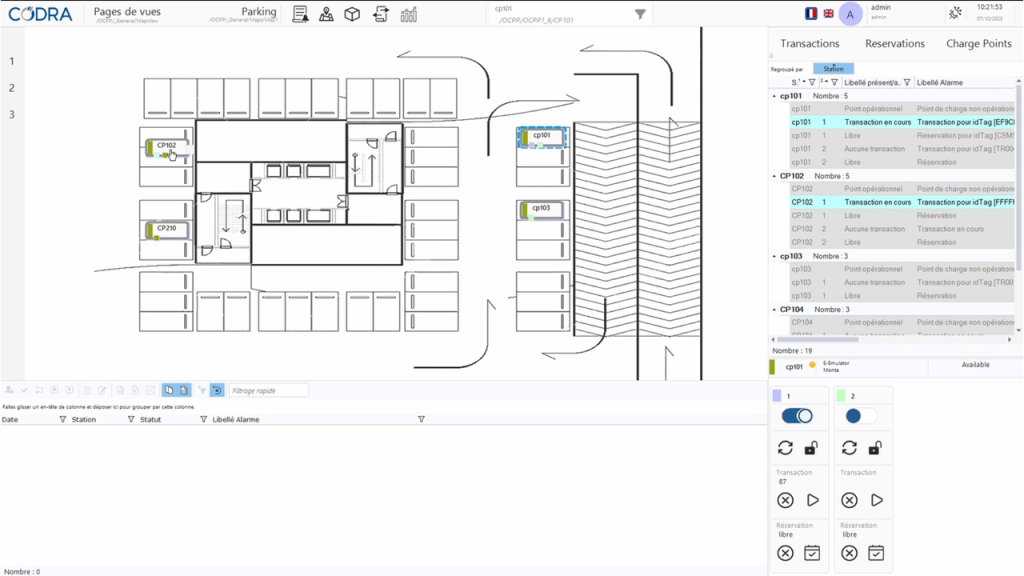
Enhanced service continuity
Panorama immediately detects loss of communication and faults, and triggers alarms as soon as a charging point becomes unavailable. Panorama keeps a record of events and enables recurring faults to be analysed. The support team prioritises interventions according to the impact on the recharging service. The manager improves the availability rate by treating the root causes and monitoring KPIs.
Energy management and smart buildings
Because the electricity consumed by charging stations is so high, they can have a major impact on a building’s energy profile. By integrating them into a SCADA application, you can monitor the charging power demand, keep a record of consumption and correlate this source with the site’s other energy consumption/distribution, such as :
- HVAC (Heating, Ventilation, Air Conditioning), which often accounts for the largest share of consumption. Adjustment levers exist, via set points and timetables.
- Photovoltaic energy, which corresponds to the building’s electricity production, and often represents most of its self-consumption capacity.
- Storage, which refers to stationary batteries. These batteries are capable of absorbing surpluses and relieving peak loads.
With all this information in a single SCADA system, the operator can build energy/carbon dashboards and prepare optimisation strategies, such as load shedding or prioritising loads.
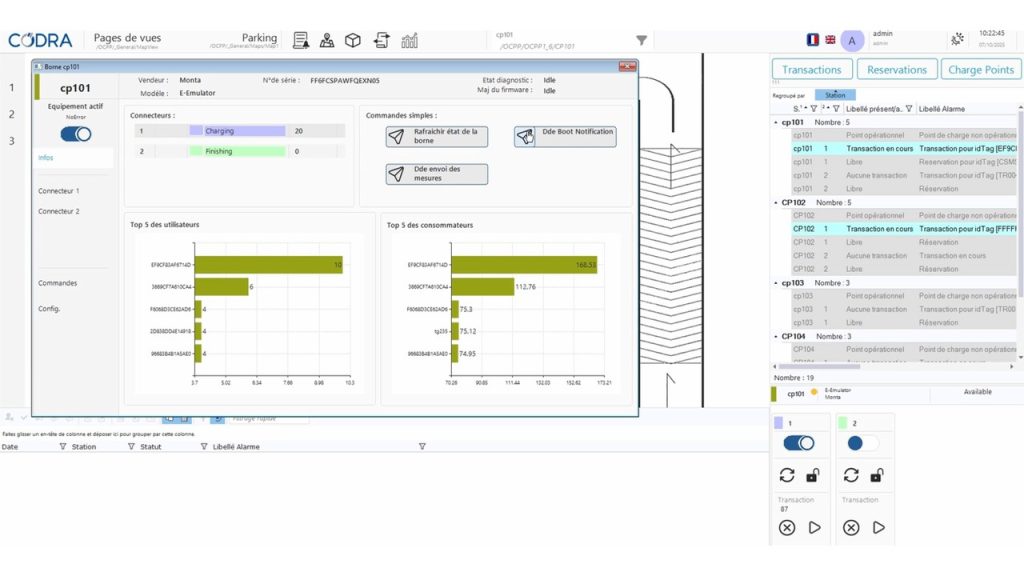
Multi-site deployment and standardisation
Panorama is a highly scalable SCADA system, making it easy to deploy across multiple sites. The integrator reuses screen, object and KPI models. The company consolidates common indicators, such as availability, energy delivered and incident volumes. The manager compares sites and identifies operating variances. This is made even easier with Panorama, as it is possible to use Edge To Service technology, enabling remote, multi-site administration of your SCADA applications.
Making SCADA directly useful to users: reserving a space and recharging
Integrating EV charging pointsinto a SCADA application should not just benefit the operator. In a commercial building, users often find it difficult to use the charging points: finding an equipped space, avoiding a faulty point, or guaranteeing access when they arrive. A function for reserving a recharging parking space turns a SCADA system into a practical service for users.
The SCADA application uses the actual status of the charging point to confirm availability, and avoids reservations when the equipment is faulty or already charging. This reduces conflicts of use, limits ‘no-load’ occupancy and improves the useful use rate of the infrastructure.
This approach also brings operational benefits. The operator obtains a forecast view of demand and measures the match between supply and requirements. The manager can make extension decisions more objective and manage service quality on the basis of factual data. Finally, SCADA plays an orchestrating role by linking the charging stations to other systems, such as the car park’s access control system, the building management system, or an internal application for employees.
Panorama, a SCADA platform compatible with the OCPP protocol
This integration and the associated benefits are only possible if the SCADA system can communicate with the charging stations, and Panorama does just that. Panorama is compatible with the OCPP protocol (Open Charge Point Protocol), which is the communication protocol used by electric charging points. The OCPP protocol reduces dependence on one manufacturer. The building can accommodate different charging points without compromising the SCADA architecture.
Multi-version support to match reality on the ground
Sites often have to deal with several generations of charging stations. Some existing installations are still based on OCPP 1.6 (JSON) equipment, while new projects or renovations favour OCPP 2.0.1 or OCPP 2.1. Panorama supports all three versions, so there’s no need for an all-or-nothing migration, and the transition phases are secure.
An important point for operations: Panorama allows these three versions to coexist in the same application. The same SCADA application can therefore cover a partially modernised old car park, a new extension, or several buildings on a campus, without multiplying the tools or segmenting the data.
A ready-to-use base thanks to the template
Panorama provides a dedicated template that speeds up integration into its SCADA application and facilitates standardisation. In particular, this template provides :
- information recording: terminal data that is useful for operations can be logged (status, events, measurements), which facilitates reports, incident analysis, transaction information and performance monitoring;
- graphic display: adaptable monitoring and synoptic screens make it possible to display the status of the park, anomalies and key information without having to start from scratch for each project;
- a component library: the integrator has access to reusable objects and standard behaviours (display logic, status management, operator actions), which reduces development times and improves maintainability.
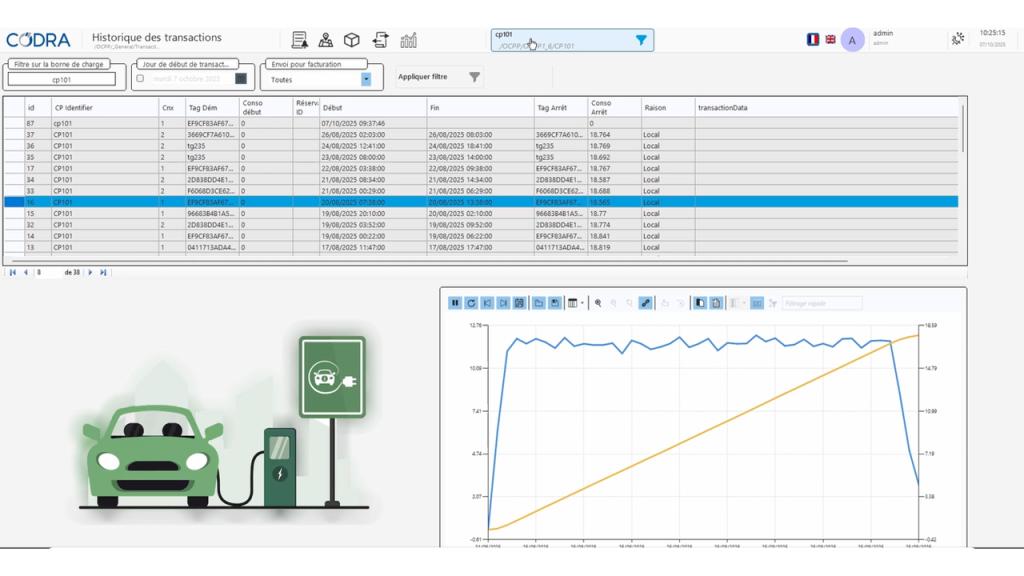
A solid foundation for car park ‘business’ services
Finally, by transferring data from the charging points to a SCADA application, Panorama provides a reliable basis for going beyond technical supervision. Real-time reports, historical data and application components make it easy to set up services such as reserving a space with charging, displaying availability to occupants, or more advanced operating scenarios (prioritisation, usage rules, internal compliance monitoring). SCADA does not remain confined to the back office: it becomes a support point for the quality of service delivered to users.
EV charging points change the nature of car parks in commercial buildings. Car parks become both an energy space and a service expected by occupants. Integrating the charging points into a SCADA application makes it possible to secure operations through unified SCADA application, alarms and KPIs, and to create value on the user side with functions such as reserving a space and recharging. With Panorama and its multi-version OCPP support, integration is based on a market standard, remains compatible with heterogeneous fleets, and can be rolled out in an industrialised way.